Studio unites creatives in unique, collaborative environment
If you want to work out your body, you join a fitness center where you can use the equipment and be motivated by others sweating it out. If you want to work out your brain,you join TechShop,where you can use professional machines and software and be inspired by other creative types thinking it out.
At least that’s how Will Brick, general manager of TechShop Detroit in Allen Park,sees it. “There are six TechShops in the country, and every one at its core is an open-to-the-public, do-it-yourself workshop and prototyping studio,” he says.“It’s like a gym for people who like to make stuff.”
The Allen Park location –it opened a year ago and was the first TechShop outside California–is a 17,000-square-foot facility that includes wood, metal, textile and welding workshops, along with state-of-the-art equipment such as laser cutters,a waterjet cutter and 3-D printers.There also is top of-the-line design software, including the entire Autodesk Design Suite.
But just as important as the equipment is the collaborative environment TechShop is dedicated to fostering, Brick says. Everything in the building is centered around the Community Hub, which contains project areas with large worktables ideal for working with others. The shop attracts everyone from college grads who no longer have access to campus equipment to retirees looking to start their own businesses to those looking fora career change.Because storage space is available, artisans can even run their businesses entirely from the center.
Ford Motor Co. also has an investment, buying large blocks of memberships to give to staff members and encouraging employees to work on prototypes at the center, according to Brick.
“Weget folks from different backgrounds and interests who come in and work together on projects,” Brick says. “We really encourage spontaneous collaboration.The people who come here represent a huge breadth and cross section of experience. They are people who wouldn’t have met otherwise.”
TechShops are membership-based;the Detroit-area location currently has approximately 900 members, Brick says. For around $100 a month, members can use and reserve the shop’s tools and equipment after completing equipment-specific Safety and Basic Use(SBU) classes.Classes average two and a half hours and usually have four to six students; cost typically runs from$40 to $100. (Veterans currently are eligible for free one-year memberships and $350 worth of group classes,see sidebar.)“No prior knowledge of the equipmentis needed,” Brick says. “We are trying to demystify the equipment and let people know it’s not only for a certain person or certain kind of work.”
Trained staff members also are available full time to help develop ideas and improve technical skills. The shop is open from 10 a.m. to 9 p.m. daily, and free tours are available at the top of every hour.
Brick encourages anyone who’s interested in the center to come,take the short tour and really get a feel for the spirit of collaboration and innovation that permeates throughout.
“We havepeople who have fantastici deas,” he says.“Where else can you introduce a young artist coming up with ideas to a 30-year tool-and-die worker,and they end up working together?”
TechShop Detroit is amembership-based, do-it-yourself workshop and prototyping studio located at 800 Republic in Allen Park. There are five other locations across the U.S., with three more in the planning stages.
Good to Know
› TechShop Detroitisopen10 a.m. to 9p.m.daily.Freetours are available everyhour.
› Theshopwill host aPost-Maker FaireOpenHouse from 10 a.m.-7 p.m. Saturday,Aug.3.The eventis opentothe public and will include toursand achancetomeetstaff.
› Formoreinfo, visitwww.techshop.com , email info.dt@techshop.com or call 313-583-3831.
OK, I admit it. I didn’t know what a makerspace was until I came to ISTE. Should I have? Probably. Am I glad I know now? Absolutely!
Makerspaces are a form of design and innovation in education that uses technology as a tool to empower students to get their ideas from thought to product. It’s a way of providing students with the space that they need to explore and extend their problem-solving skills through a tactile environment. It comes in many different forms but usually contains a physical space stocked with many different types of materials and provides coaching from teachers to guide students through the design cycle: investigate, design, test and create.
I first heard the term makerspace at the beginning of the ISTE conference during a Hack Education session. Diane Main (@dowbiggin), one of the leading contributors to the discussion, caught my attention with her enthusiasm for the topic. It was there that I was first introduced to Make Magazineas a valuable resource for makerspaces. Soon, I began hearing about makerspaces everywhere, including during a personal and inspiring conversation with Gregory Hill (@mrsenorhill), who is leading a ground-breaking project with his Disruption Department in St. Louis.
Most recently, I explored the essence of design and technology tools for innovation at the Imagine, Invent and Innovate session with Lucie De La Bruere. In this session, we explored tools like 123d Design, which is similar to Sketch Up and Hop Scotch, which is similar to Scratch. Using these tools, we explored how we can extend the use of iOS devices beyond consumption to robust creation experiences. Through these creations, students are able to communicate their ideas and designs for future makerspace products and speed down the road of innovation toward entrepreneurship.
As we watched the inspirational video Imagine It about the innovation project sponsored by Stanford, I realized that this is yet another example of the main theme that is circulating throughout the various presentations, speeches and conversations at ISTE 2013: Students must be involved, inspired, and emotionally invested in their learning to develop the 21st century skills that they need for the future. Whether it’s through gaming, programming, presenting or creating, it’s our responsibility to help facilitate student engagement with the curriculum and connect students with the technological tools they need to succeed.
“We must reimagine middle school science and math not as a way to prepare students for high school, but as a place where students are inventors, scientists, and mathematicians today.”
So say Sylvia Martinez and Gary Stager in this exciting guest article about the Maker Movement and its implications for kids, schools and STEM studies.
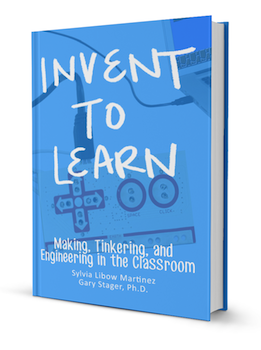
Martinez and Stager are the authors of a must-read book, Invent To Learn: Making, Tinkering, and Engineering in the Classroom. In this informative post, they encourage STEM educators, school leaders and teachers across the curriculum to transform our classrooms into centers of innovative thinking and experimenting. ~ Anne Jolly
InventtoLearn:Makersintheclassroom
by Sylvia Libow Martinez & Gary S. Stager
Sylvia Libow Martinez
The last decade and more has been a dark period for many schools. Emphasis on high-stakes standardized testing, de-professionalizing teachers, and relying on data rather than teacher expertise has created classrooms that are increasingly devoid of play, rich materials, and the time to engage in meaningful projects.
What’s more, the national rhetoric about the importance of STEM subjects (Science, Technology, Engineering, and Math) has sadly, for many schools, not been reflected in a revitalization of science or math curriculum.
Fortunately, there’s a technological and creative revolution underway that may change everything – the Maker Movement.
Amazing new tools, materials, and skills turn us all into makers. Using technology to make, repair, or customize the things we need brings engineering, design, and computer science to the masses. Hundreds of thousands of adults and children are frequenting Maker Faires, hackerspaces, and DIY (Do-It-Yourself) websites. A growing library of literature inspires learners of all ages and experiences to seize control of their world.
Gary S. Stager
Online communities serve as the hub of a digital learning commons, allowing people to share not just ideas, but the actual programs and designs for what they’ve invented. This ease of sharing lowers the barriers to entry as newcomers can easily use someone else’s code and design as building blocks for their own creations.
Fortunately for educators, this maker movement overlaps with the natural inclinations of curious children and the power of learning by doing. It holds the keys to reanimating the best, but oft-forgotten learner-centered teaching practices. The magic of the middle years, where students can shift seamlessly between childhood play and preparation for serious academics are the perfect place for these engaging, transformative new tools and materials.
TheMakerkids
The maker movement celebrates the talents of young people like Sylvia (aka Super-Awesome Sylvia) who has a web-broadcast program, Sylvia’s Super-Awesome Maker Show, where she sings, plays, and teaches her millions of viewers about electronics, Arduinos, and other fun projects.
Eighth grader Joey Hudy is a young maker and entrepreneur who surprised President Obama with a homemade marshmallow cannon at the White House Science Fair. Here’s the raw video footage, with the President providing some muscle power.
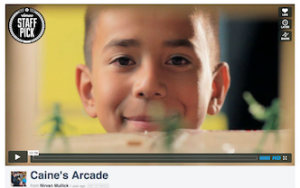
Caine Munroy is a young man who made an entire game arcade entirely out of cardboard and tape. A neighbor fell in love with Caine’s ingenuity and asked his father if he could make a video about the arcade. Not long after,Caine’s Arcade lit up YouTube. Caine and his arcade have inspired millions of people around the world. He’s received invitations to visit other countries, a scholarship fund was created for his college education, and a foundation was created to nurture creativity in kids across the globe. Los Angeles Mayor Antonio Villaraigosa even gave Caine a cardboard key to the city! (See Caine’s TEDx appearance here.)
Of course these are extraordinary young people — but there are extraordinary young people in every city, every school, and every classroom who deserve the same opportunities to express themselves by inventing, creating, and making.Artandinvention
Awesome Sylvia Todd
Children’s seminal learning experiences come through direct experience with materials, especially in STEM subjects. Digital fabrication devices such as 3D printers and physical computing, including Arduino, MaKey MaKey andRaspberry Pi expand a child’s toy chest and toolbox with new ways to make things and new things to make. For the first time ever, childhood inventions may be printed, programmed, or animated with interactivity.
While school traditionally separates art and science, theory and practice, such divisions are artificial. The only reason we are even discussing STEAM (adding Arts to STEM) is that so many schools removed art from the curriculum. The real world just doesn’t work that way! Architects are artists. Craftsmen deal in aesthetics, tradition, and mathematical precision. Video game designers rely on computer science. Engineering and industrial design are inseparable.
Children naturally invest their own inventions with an esthetic component when given agency over their own creations. The maker community brings children, hobbyists, and professionals together in a glorious celebration of personal expression with a modern flare. There is no reason that schools cannot do the same.
Themakerrevolution
Three game-changers should be on every school’s radar:
Computer controlled fabrication devices – Over the past few years, devices that fabricate three-dimensional objects have become an affordable reality. These 3D printers can take a design file and output a physical object. Plastic filament is melted and deposited in intricate patterns that build layer by layer, much like a 2D printer prints lines of dots that, line by line, create a printed page. With 3D design and printing, the ability for students to design and create their own objects combines math, science, engineering, and craft.
Physical computing – New open source microcontrollers, sensors, and interfaces connect the physical world to the digital world in ways never before possible. Many schools are familiar with robotics, one aspect of physical computing, but a whole new world is opening up. Wearable computing – where circuits are made with conductive thread – makes textiles smart, flexible, and mobile. Plug and play devices that connect small microprocessors to the Internet, to each other, or to any number of sensors mean that low cost, easy-to-make computational devices can test, monitor, and explore the world.
Programming – There is a new call for programming in schools, from the Next Generation Science Standards to the White House. Programming is the key to controlling this new world of computational devices and the range of programming languages has never been greater. Today’s modern languages are designed for every purpose and every age.
One might try to marginalize robotics or 3D fabrication as having nothing to do with “real” science, dismissed as play, or as just a super-charged hobby. However, today’s new low-cost, flexible, creative, and powerful materials should be viewed as building blocks for today’s children and their STEM interests.
This is much more than just “hands-on” crafting – these tools bring electronics, programming, and computational mathematics together in meaningful, powerful ways. We must reimagine middle school science and math not as a way to prepare students for high school, but as a place where students are inventors, scientists, and mathematicians today.
Challenging“hardfun”throughtinkering
The tools and ethos of the maker revolution offer insight and hope for middle schools. The breadth of options and the “can-do” attitude is exactly what students need, especially girls as this is the age they tend to opt out of science and math.
But hands-on making is not just a good idea for girls; all students need challenge and “hard fun” that leads to big ideas and inspires them to dive deeper.
Making science interesting and fun is not pandering to young sensibilities; it honors the learning drive and spirit that is all too often crushed by endless worksheets and boring vocabulary drills. Making is a way of bringing engineering to young learners. Such concrete experiences provide a meaningful context for understanding abstract science and math concepts.
Tinkering is a powerful form of learning by doing, an ethos shared by the rapidly expanding maker community and many educators. Tinkering is the process of design, the way that real science and engineering is done. We owe it to our children to give them the tools and experiences that real scientists and engineers use, and the time is now to bring these tools and learning opportunities into real classrooms. There are multiple pathways to learning what we have always taught, and things to do that were unimaginable just a few years ago.
Startwiththeresourcesathand
Even if educators don’t have access to expensive (but increasingly affordable) hardware, every classroom can become a makerspace where kids and teachers learn together through direct experience with an assortment of high- and low-tech materials. The potential range, breadth, power, complexity, and beauty of projects have never been greater thanks to the amazing new tools, materials, ingenuity, and playfulness found in today’s maker materials. Turning every classroom into a makerspace and every child into a maker is the path to creating truly personal learning for every student.
Additionalresources
• Invent To Learn: Making, Tinkering, and Education in the Classroom - This website is the home of our groundbreaking book. It gives educators a practical guide to bringing 21st century tools, technology, and pedagogy to any classroom. We also include recommended books and hundreds of links to resources and professional development for making, tinkering, and engineering in the K-12 classroom.
• Video– Making in Education – Gary Stager’s interview with Steve Hargadon at the 2012 San Mateo Maker Faire.
• Constructing Modern Knowledge – a premier event for teacher professional learning with the tools and materials of the 21st century.
• Learning by Making: American kids should be building rockets and robots, not taking standardized tests, aSlate magazine article by Dale Dougherty.
• Make magazine – The bible of the Maker Movement, for adults and young people.
• Why I LOVE My 3D Printer (and you will too!) is a video of a passionate talk by 12-year-old Schuyler St. Leger.
• Sylvia’s Super Awesome Maker Show is a video series produced by Sylvia Todd, an 11-year-old maker, and her father. Her videos are youthful and vibrant examples of playful technology. The New York Times recently wrote a profile that will interest educators.
___
Sylvia Libow Martinez is President of Generation YES, a non-profit with a mission of empowering young people to improve their schools and communities with modern technology. Sylvia holds a B.S. in electrical engineering and a master’s degree in Education Technology and works in schools around the world to bring the power of authentic learning into classrooms, particularly in STEM subjects. In earlier careers, she was an aerospace engineer and senior scientist researching GPS navigational satellite systems.
Gary S. Stager is a leading expert and advocate for computer programming, robotics and learning-by-doing in classrooms and a pioneer in developing online learning systems. In addition to being a popular bloggerand keynote speaker, Gary is a journalist, teacher educator, consultant, professor and software developer, and founder of the Constructing Modern Knowledge summer institute for educators.


 Classroom Tinkers & Inventors


 Physical computing – New open source microcontrollers, sensors, and interfaces connect the physical world to the digital world in ways never before possible. Many schools are familiar with robotics, one aspect of physical computing, but a whole new world is opening up. Wearable computing – where circuits are made with conductive thread – makes textiles smart, flexible, and mobile. Plug and play devices that connect small microprocessors to the Internet, to each other, or to any number of sensors mean that low cost, easy-to-make computational devices can test, monitor, and explore the world.
 But hands-on making is not just a good idea for girls; all students need challenge and “hard fun” that leads to big ideas and inspires them to dive deeper.